Origami, the art of folding sheets of paper, has been appreciated as a source of inspiration for structural design. Structural origami is a field that is rapidly developing through a collaboration between engineering, design, art, and computation. This paper introduces aspects of structural origami, to share recent exciting developments in this field.
Tomohiro Tachi, "Introduction to Structural Origami," Journal of the International Association for Shell and Spatial Structures, Vol. 60 (2019) No. 1 March n. 199, pp. 7-18(12), DOI[pdf]
Pseudo-Bellows
Bellows theorem says that a polyhedron cannot change its volume while keeping its facets rigid.
This forbids a lot of potential applications of origami engineering, e.g., bellows, pneumatic or hydralic actuators, compactly foldable containers, etc.
There are many ways to "cheat" this theorem. One is to allow for a very small amount of stretch. The other is to add a small amount of slit.
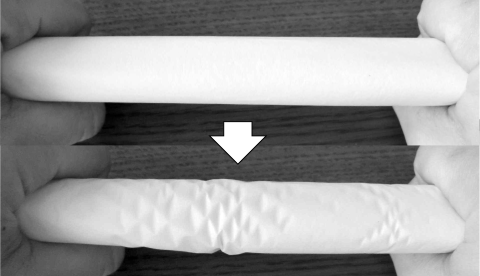
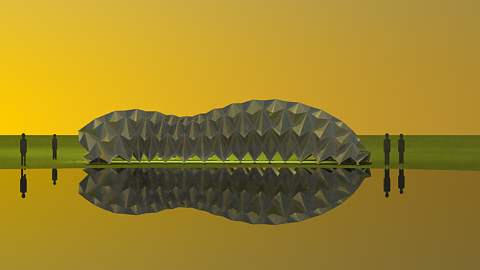
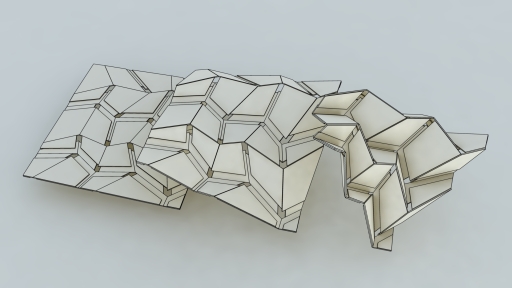
Transformable Cap with Small Stretch
Origami-based deployable systems that encloses a volume can be actuated through pneumatics or hydraulics.
The potential applications include deployment of spatial structures and metamaterials that can be tuned by pressures.
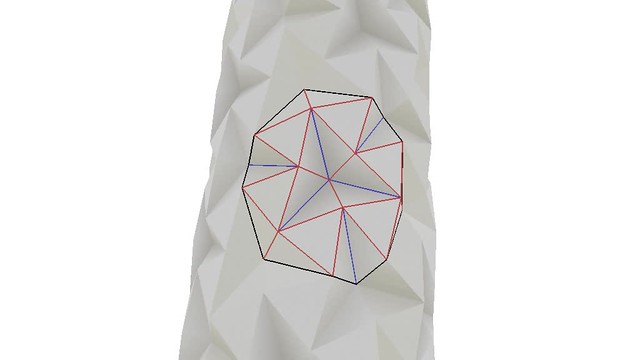
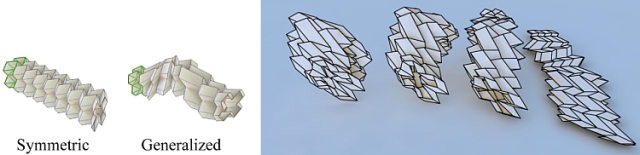
Rigid origami tubes and their assembly can form such a transformable and tunable material, but the end design to cap the tubular system making into a closed system has been an unsolved issue.
In fact, this issue is mathematically proved to be unsolvable by the Bellows theorem, which says that a closed polyhedron cannot change its volume when each facet keeps isometry.
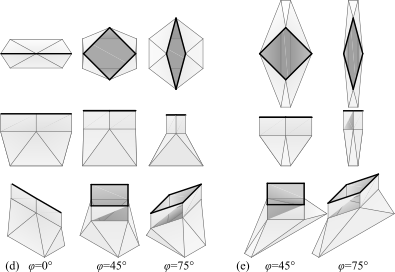
We find an engineering way-around to this problem to produce a close-to-rigid-foldable cap designs for rigid foldable tubes.
Specifically, we introduce a parametric design of infinitesimally rigid foldable structures and multi-stable structures that can fit to a transformable planar parallelogram section.
This structure can be attached to the ends of a rigid foldable origami tube to cap them.
The proposed structure can act as a component to build bellows or hydraulic actuators, as well as the method for creating a compliant covering of scissors mechanisms.
Tomohiro Tachi, "Capping Rigid Origami Tube", Proceedings of IASS Symposium 2017, September 2017, Hamburg, Germany [pdf].
Flattening Tetrahedron with Slit Collaboration with Z. Abel, R. Connelly, E.D. Demaine, M.L. Demaine, T. C. Hull, A. Lubiw
Cauchy showed that if the faces of a convex polyhedron are rigid then the whole polyhedron is rigid. Connelly showed that this is true even if finitely many extra creases are added.
However, cutting the surface of the polyhedron destroys rigidity and may even allow the polyhedron to be flattened.
We initiate the study of how much the surface of a convex polyhedron must be cut to allow continuous flattening with rigid faces.
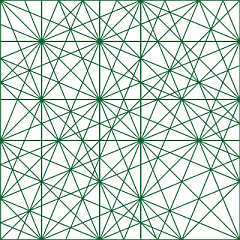
We show that a regular tetrahedron with side lengths 1 can be continuously flattened with rigid faces after cutting a slit of length .046 and adding a few extra creases.
Zachary Abel, Robert Connelly, Erik D. Demaine, Martin Demaine, Thomas Hull, Anna Lubiw and Tomohiro Tachi : "Rigid Flattening of Polyhedra with Slits ," in Abstracts for the Sixth International Conference on Origami in Science, Mathematics, and Education (6OSME), 2014. [pdf]
Reconfigurable Origami Tubes
Collaboration with Evgueni T. Filipov and Glaucio H. Paulino
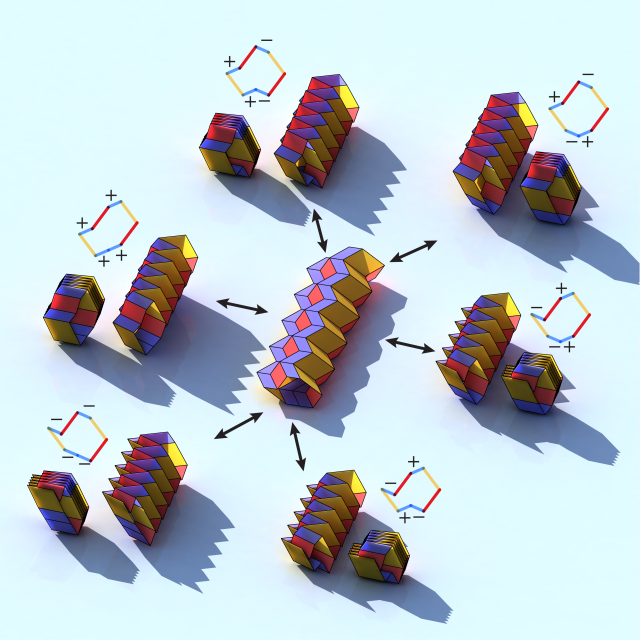
Thin sheets can be assembled into origami tubes to create a variety of deployable, reconfigurable, and mechanistically unique three dimensional structures.
We introduce and explore origami tubes with polygonal, translational symmetric cross-sections, that can reconfigure into numerous geometries. The tubular structures satisfy the mathematical definitions
for flat and rigid foldability, meaning that they can fully unfold from a flattened state with deformations occurring only at the fold lines. The tubes do not need to be straight, and can be constructed to follow a nonlinear curved line when deployed. The cross-section and kinematics of the tubular structures can be reprogrammed by changing the direction of folding at some folds.
We discuss the variety of tubular structures that can be conceived and we show limitations that govern the geometric design. We quantify the global stiffness of the origami tubes through eigenvalue and structural analyses and highlight the mechanical characteristics of these systems. The two-scale nature of the present work indicates that, from a local viewpoint, the crosssection
of the polygonal tubes are reconfigurable while, from a global viewpoint, deployable tubes of
desired shapes are achieved. This class of tubes has potential applications ranging from pipes and microrobotics to deployable architecture in buildings.
Collaboration with Evgueni T. Filipov and Glaucio H. Paulino
Origami, the ancient art of folding paper, has recently emerged as a method for creating deployable and reconfigurable engineering systems. These systems tend to be flexible because the thin sheets bend and twist easily. We introduce a new method of assembling origami into coupled tubes that can increase the origami stiffness by two orders of magnitude. The new assemblages can deploy through a single flexible motion, but they are substantially stiffer for any other type of bending or twisting movement. This versatility can be used for deployable structures in robotics, aerospace, and architecture. On a smaller scale, assembling thin sheets into these tubular assemblages can create metamaterials that can be deployed, stiffened, and tuned.
Rigid Origami Vertices: Conditions and Forcing Sets
Collaboration with Zachary Abel, Jason Cantarella, Erik D. Demaine, David Eppstein, Thomas C. Hull, Jason Ku, and Robert J. Lang.
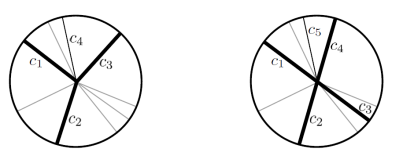
We give a necessary and sufficient condition that characterizes rigidly foldable single vertex crease patterns. We believe that this serves as the basic theorem for rigid-foldable origami, as an equivalent of Kawasaki's and Maekawa's theorems for flat-foldable origami.
In addition, we introduce the concept of a forcing set for rigidly-foldable vertices. A forcing set is a subset of the creases whose folded state uniquely determines the folded state of the remaining creases.
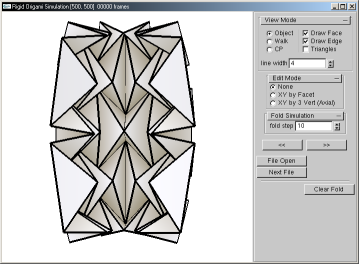
We investigate the continuous rigid folding motion of an origami tessellation structure when their pattern is infinitely tessellating a plane with periodic symmetry. We analytically and numerically describe the kinematics of triangular origami tessellation by assuming that the fold configuration, as well as the pattern, is periodic. Owing to the geometric constraints, the global forms of these tessellations are always restricted to cylindrical configurations unlike the folding of a finite open origami tessellation, which allows
a double curved surface. In such triangulated patterns, the number of fold angles representing the configuration of the fundamentalfigure is equal to the number of equations from rigid origami constraints. However, this forms a two degrees of freedom mechanism instead of being statically determinate. One of the degrees of freedom represents the folding-unfolding motion, and the other represents the change in the orientation of the rolling axis.
Tomohiro Tachi "Rigid Folding of Periodic Origami Tessellations", to appear in Origami6, 2015.
Characterization of Curved Creases and Rulings
Collaboration with Erik D. Demaine, Martin L. Demaine, David A. Huffman, Duks Koschitz
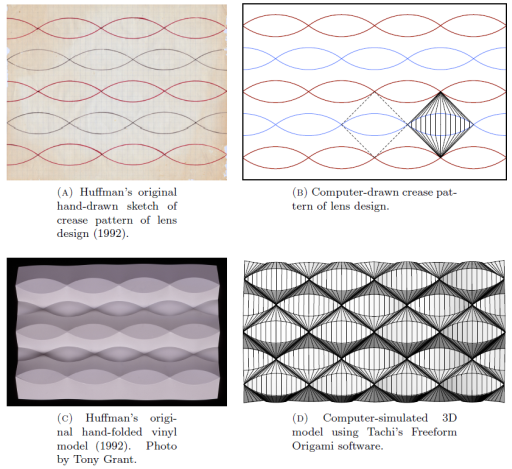
We describe a general family of curved-crease folding tessellations consisting of a repeating "lens" motif formed by two convex curved arcs. The third author invented the first such design in 1992, when he made both a sketch of the crease pattern and a vinyl model (pictured below). Curve fitting suggests that this initial design used circular arcs. We show that in fact the curve can be chosen to be any smooth convex curve without inflection point. We identify the ruling configuration through qualitative properties that a curved folding satisfies, and prove that the folded form exists with no additional creases, through the use of differential geometry.
Erik D. Demaine, Martin L. Demaine, David A. Huffman, Duks Koschitz, Tomohiro Tachi "Characterization of Curved Creases and Rulings: Design and Analysis of Lens Tessellations" to appear in Origami6, 2015.
Origami interleaved tube cellular materials
Collaboration with Kenneth C. Cheung, Sam Calisch, and Koryo Miura
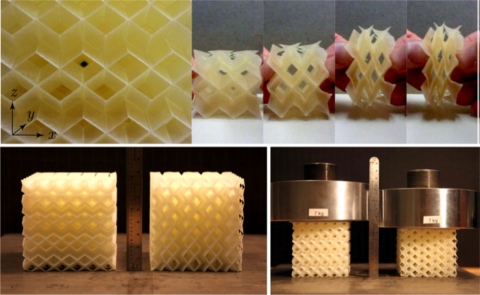
A novel origami cellular material based on a deployable cellular origami structure is described. The structure is bi-directionally flat-foldable in two orthogonal (x and y) directions and is relatively stiff in the third orthogonal (z) direction. While such mechanical orthotropicity is well known in cellular materials with extruded two dimensional geometry, the interleaved tube geometry presented here consists of two orthogonal axes of interleaved tubes with high interfacial surface area and relative volume that changes with fold-state. In addition, the foldability still allows for fabrication by a flat lamination process, similar to methods used for conventional expanded two dimensional cellular materials. This article presents the geometric characteristics of the structure together with corresponding kinematic and mechanical modeling, explaining the orthotropic elastic behavior of the structure with classical dimensional scaling analysis.
Kenneth C Cheung, Tomohiro Tachi, Sam Calisch and Koryo Miura, "Origami interleaved tube cellular materials", Smart Materials and Structures, 23(9), 2014 doi:10.1088/0964-1726/23/9/094012
Composite Rigid-Foldable Curved Origami Structure
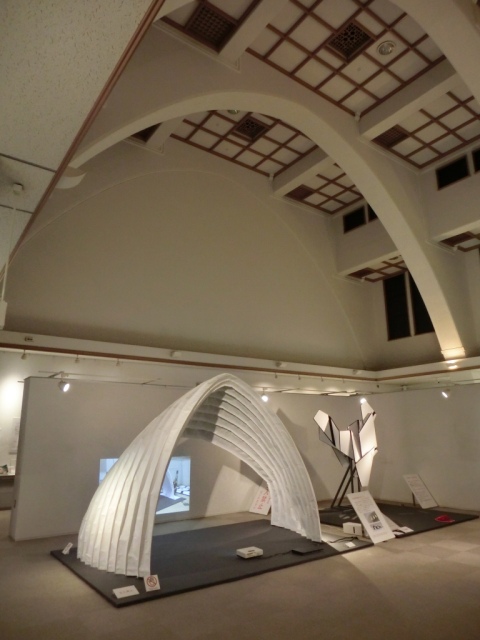
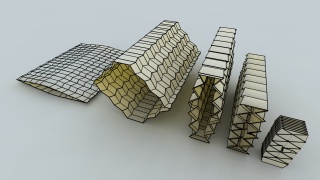
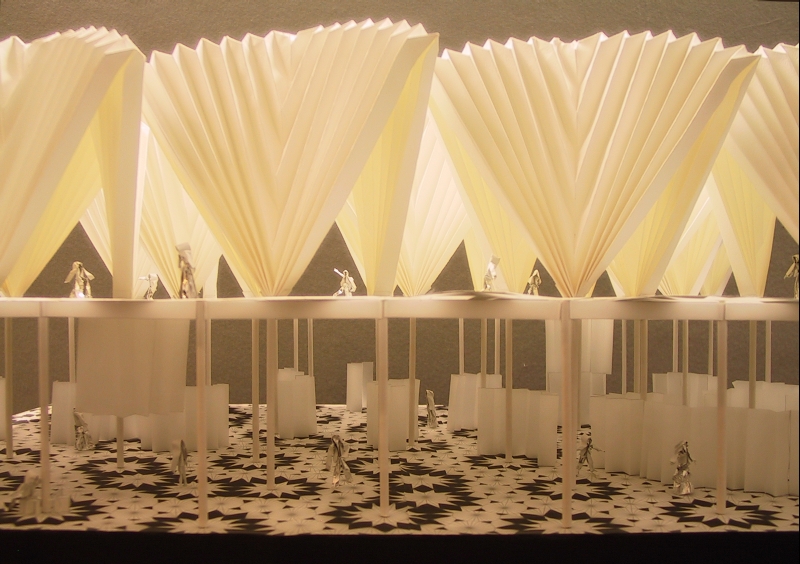
In this study, we show a family of multilayered rigid-foldable and flat-foldable vault structures, which can be designed by constructing rigid-foldable curved folded tubular arches and assembling the arches to construct cellular structures. The resulting vault structure form an overconstrained mechanism.
Tomohiro Tachi, "Composite Rigid-Foldable Curved Origami Structure", in Proceedings of Transformables 2013, Seville, Spain, September 18-20, 2013. [pdf]
Elastic Origami
In this research, we propose a novel computational method to simulate and design origami whose form is governed by the equilibrium of forces from the elastic bending of each panel. In special, we explore statically indeterminate origami structure that can be manipulated by pin supporting finite number of vertices. The computational method is proposed so that we can interactively explore the design space of such origami form. The concept of kinematic origami tessellation based on bending of panels is introduced.
Tomohiro Tachi, "Interactive Form-Finding of Elastic Origami", in Proceedings of IASS 2013, Wroclaw, Poland, September 23-27, 2013. [pdf]
Freeform Origami Tessellations based on Generalized Resch's Patterns
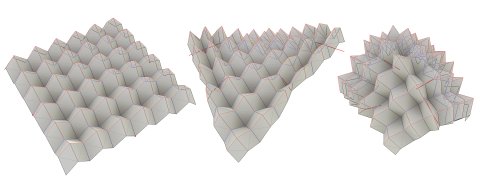
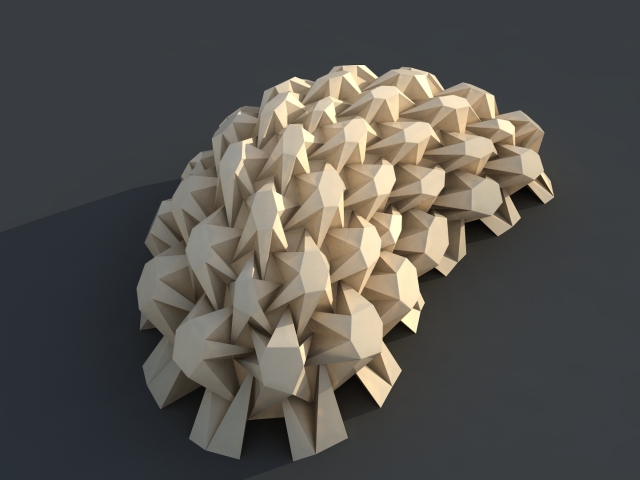
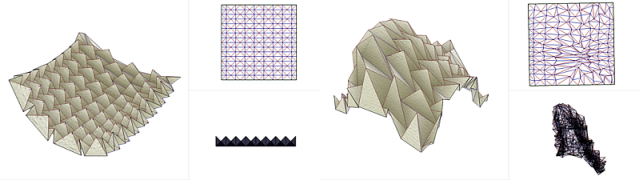
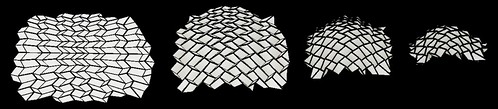
In this research, we study a method to produce families of origami tessellations from given polyhedral surfaces. The resulting tessellated surfaces generalize the patterns proposed by Ron Resch and allow the construction of an origami tessellation that approximates a given surface. We will achieve these patterns by first constructing an initial configuration of the tessellated surfaces by separating each facets and inserting folded parts between them based on the local configuration. The initial configuration is then modified by solving the vertex coordinates to satisfy geometric constraints of developability, folding angle limitation, and local nonintersection. We propose a novel robust method for avoiding intersections between facets sharing vertices. Such generated polyhedral surfaces are not only applied to folding paper
but also sheets of metal that does not allow 180◦ folding.
Tomohiro Tachi, "Designing Freeform Origami Tessellations by Generalizing Resch's Patterns", Journal of Mechanical Design, Special Issue on Origami and Tessellation in Design, to appear.
Tomohiro Tachi, "Freeform Origami Tessellations by Generalizing Resch's Patterns", Proceedings of ASME 2013 IDETC/CIE (Symposium on Origami-Based Engineering Design), DETC2013-12326, Portland, USA, August 4-7, 2013 [pdf]
Rigid-Foldable Cylinders and Cells collaboration with Koryo Miura
In this research, we present newly explored families of rigid-foldable cylinders and the cellular structures constructed from these cylinders; the families include zonogon extrusion cells, bi-directionally flat-foldable cells, and a novel type of cells, i.e., woven cylinder cells. We show the geometry of such structures to demonstrate their validity, their parametric design method, and their kinetic behaviors. These types of structures exhibit continuous rigid-foldability as well as flat-foldability in one or two directions; further, they have different kinetic properties that are potentially applicable for different purposes. The newly proposed woven cylinder cellular structure is a bi-directionally flat-foldable one-DOF rigid-foldable structure and has a distinctive geometric property: structural stiffness against compression in one of three directions.
Tomohiro Tachi and Koryo Miura, "Rigid-Foldable Cylinders and Cells", Journal of the International Association for Shell and Spatial Structures (IASS), 53(4), pp. 217--226, 2012. [pdf](draft)
Shaky Polyhedron
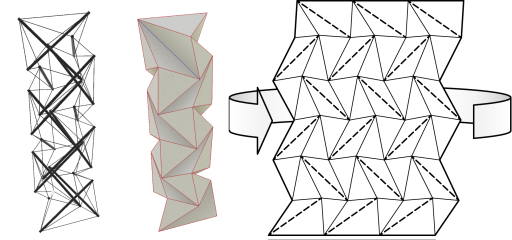
We investigate novel computational design method for infinitesimally and finitely foldable rigid origami based on solving a first-order folding mode, which can be represented by a reciprocal figure. We derive these graphical conditions from a matrix representation of rigid origami, and extend the conditions to cases when the surface includes holes. We propose an algorithm to obtain forms that satisfy the conditions and an interactive system to freely design infinitesimally foldable forms. We show design examples of shaky polyhedron
and origami, and finitely foldable quadrivalent mesh origami. The graphical equivalence between Tensegrity and Origami is also mentioned.
Tomohiro Tachi, "Design of Infinitesimally and Finitely Flexible Origami Based on Reciprocal Figures", Journal for Geometry and Graphics, 16(2), 223--234, 2012. [pdf]
Freeform Tensegrity
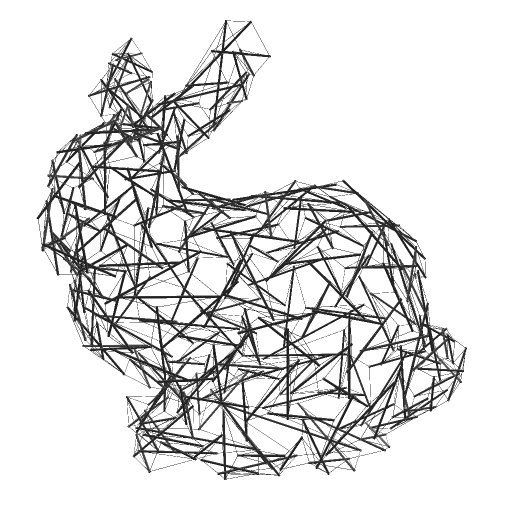
We propose a novel interactive method for flexibly designing tensegrity structures under valid force equilibriums. Unlike previous form-finding techniques that aim to obtain a unique solution by fixing some parameters such as the lengths of elements and force densities, our method provides a design system that allows a user to continuously interact with the form within a multidimensional solution space. First, a valid initial form is generated by converting a given polygon mesh surface into a strut-and-cable network that approximates the mesh, and the form is then perturbed to attain an equilibrium state through a two-step optimization of both node coordinates and force densities. Then, the form can be freely transformed by using a standard 2D input device while the system updates the form on the fly based on the orthogonal projection of a deformation mode into the solution space. The system provides a flexible platform for designing a tensegrity form for use as a static architectural structure or a kinetic deployable system.
Tomohiro Tachi, "Interactive Freeform Design of Tensegrity", in Proceedings of Advances in Architectural Geometry 2012, Paris, France, to appear, September 27-30, 2012.[pdf]
Rigid Origami Structures with Vacuumatics collaboration with Motoi Masubuchi, and Masaaki Iwamoto
『やわらかな剛体』, 形態創生コンテスト2011 最優秀作品, 日本建築学会 2011,10/27
Tomohiro Tachi, Motoi Masubuchi, and Masaaki Iwamoto, "Rigid Origami Structures with Vacuumatics: Geometric Considerations", in Proceedings of the IASS-APCS 2012, Seoul, Korea, May 21-24, 2011. [pdf]
Rigid Origami Structures 2006-
We have been studying rigid origami structures. The following paper is a brief general introduction to rigid origami studies.
Tomohiro Tachi, "Geoemtric Considerations for the Design of Rigid Origami Structures", in Proceedings of IASS Symposium 2010, Shanghai, China, pp. 771-782, 2010.[pdf]
We show a novel design method of one-DOF deployable mechanism based on a space curve, through creating a curved folding and discretizing the folding into rigid origami. By interpreting constant angle curved folding as a flat-foldable quadrilateral mesh origami, we design novel irregular tessellated, cylindrical, and cellular flatly collapsible structures, whose behavior is easily controlled by space curves.
Tomohiro Tachi, "One-DOF Rigid Foldable Structures from Space Curves", in Proceedings of the IABSE-IASS Symposium 2011, London, UK, September 20-23, 2011. [pdf]
Designing One-DOF Mechanisms by Rationalizing Curved Folding collaboration with Gregory Epps
We propose a modeling method based on rationalizing curved folding in order to find the form variations of 1DOF origami mechanism.
We interact with a physical paper model of curved folding and then discretize a curved folding by identifying and fixing the rulings.
The discretized form is a rigid origami structure with at most one degree of freedom.
The form adjustment follows the discretization so that it is sure to realize a mechanism.
The workshop performed by the authors based on the proposed design method is reported.
The objective of the workshop was to utilize the 1DOF characteristic of discretized curved folds as a constraint in the design of dynamic architectural components.
The results showed the feasibility of the method and suggested a novel methodology for designing.
Gregory Epps and Tomohiro Tachi, "One DOF linkage manipulation using rigid origami", workshop held at Advances in Architectural Geometry 2011, Wien, Austria, September 18-19, 2010.[url]
Tomohiro Tachi and Gregory Epps, "Designing One-DOF Mechanisms by Rationalizing Curved Folding", in Proceedings of ALGODE 2011, Tokyo, Japan, March 14-16, 2011.[pdf]
Rigid-Foldable Cylindrical Polyhedra collaboration with Koryo Miura
We present a family of rigid-foldable collapsible cylindrical polyhedra which is of great interest of structural engineering field. The symmetry operations in order to synthesize the cylindrical structures and their space filling tessellation are shown.
presented at ISIS-Symmetry 2010, Gmuend, Austria
Koryo Miura and Tomohiro Tachi, "Synthesis of Rigid-Foldable Cylindrical Poyhedra", Journal of the International Society for the Interdisciplinary Study of Symmetry (ISIS-Symmetry), Special Issues for the Festival-Congress Gmuend, Austria, August 23-28, pp. 204-213, 2010. [pdf]
Freeform Rigid-Foldable Structure using Bidirectionally Flat-Foldable Planar Quadrilateral Mesh
We present a computational design method to obtain collapsible variations of rigid-foldable surfaces, i.e., continuously and finitely transformable polyhedral surfaces, homeomorphic to disks and cylinders.
Two novel techniques are proposed to design such surfaces: a technique for obtaining a freeform variation of a rigid-foldable and bidirectionally flat-foldable disk surface, which is a hybrid of generalized Miura-ori and eggbox patterns, and a technique to generalize the geometry of cylindrical surface using bidirectionally flat-foldable planar quadrilateral mesh by introducing additional constraints to keep the topology maintained throughout the continuous transformation.
Tomohiro Tachi, "Freeform Rigid-Foldable Structure using Bidirectionally Flat-Foldable Planar Quadrilateral
Mesh", in Advances in Architectural Geometry 2010, Vienna, Austria, September 18-21, pp. 87-102, 2010. [pdf]
Freeform Variations of Origami
We present a novel method to obtain a 3D freeform surface that can be constructed by folding a sheet of paper. Specifically, we provide a design system within which the user can intuitively vary a known origami pattern in 3D while preserving the developability and other optional conditions inherent in the original pattern. The system successfully provides designs of 3D origami that have not been realized thus far.
Tomohiro Tachi, "Freeform Variations of Origami", Journal for Geometry and Graphics, 14(2), pp. 203-215, 2010. [pdf]
Angular Grid System collaboration with Erik D. Demaine
We consider the construction of points within a square of paper by drawing a line (crease) through an existing point with angle equal to an integer multiple of 22.5 degrees, which is a very restricted form of the Huzita-Justin origami construction axioms.
We show that a point can be constructed by a sequence of such operations if and only if its coordinates are both of the form (m + n*sqrt(2))/(2^l) for integers m, n, and l, and that all such points can be constructed efficiently.
This theorem explains how the restriction of angles to integer multiples of 22.5 degrees forces point coordinates to degenerate into a reasonably controlled grid, i.e., Maekawa-gami.
Presented at 5OSME, Singapore, July 2010.
Abstract [url]
Thick Rigid Origami
We propose a novel geometric method to implement a general rigid-foldable origami as a structure
composed of tapered or non-tapered (constant-thickness) thick plates and hinges
without changing the mechanical behavior from that of the ideal rigid origami.
In general, a quadrilateral mesh surface does not enable a continuous rigid motion because an overconstrained system is constructed.
We generalize the geometric condition for enabling one-DOF rigid motion in general quadrilateral mesh origami without the trivial repeating symmetry.
This yields a variety of unexplored generalized shapes of quadrilateral mesh origami that preserve finite rigid-foldability in addition to developability and flat-foldability.
Presented at IASS Symposium 2009, Valencia 28 September - 2 October 2009, Universidad Politecnica de Valencia, Spain
for details refer
Tomohiro Tachi, "Generalization of Rigid Foldable Quadrilateral Mesh Origami," Journal of the International Association for Shell and Spatial Structures, 50(3), pp. 173-179, 2009.
Tomohiro Tachi, "Generalization of Rigid Foldable Quadrilateral Mesh Origami," Proceedings of the IASS Symposium 2009, pp. 2287-2294, 2009.
pdf (1.4MB)
We present a novel cylindrical deployable structure and variations of its design
with the following characteristics:
Flat-foldable: The shape flattens into a compact 2D configuration.
Rigid-foldable: Each element does not deform throughout the transformation.
One-DOF: The mechanism has exactly one degree of freedom.
Thick: Facets can be substituted with thick or multilayered panels without introducing the distortion of elements.
Presented at IASS Symposium 2009, Valencia 28 September - 2 October 2009, Universidad Politecnica de Valencia, Spain
for details refer
Tomohiro Tachi, "One-DOF Cylindrical Deployable Structures with
Rigid Quadrilateral Panels," in Proceedings of the IASS Symposium 2009, 2009, pp. 2295-2305.
pdf (3.2MB)
Kushakusha
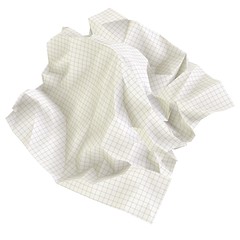
This is a novel interactive system that enables a user to design crumpled papers.
Software will be available soon.
Origamizing Polyhedral Surfaces
The first practical method for "origamizing" or obtaining the folding pattern that folds a single sheet of material into a given polyhedral surface without any cut is shown.
For the details
Tomohiro Tachi, "Origamizing Polyhedral Surfaces," IEEE Transactions on Visualization and Computer Graphics, 16(2), pp. 298-311, 2010.
pdf (1.2MB)
Smooth Origami Animation by Crease Line Adjustment (SIGGRAPH 2006 poster)
I propose a method for making a smooth and comprehensible origami animation from crease pattern to folded base, by adding and adjusting crease lines on an origami model.
Full-Spectral Image-Based Lighting with Skylight (SIGGRAPH 2005 poster)
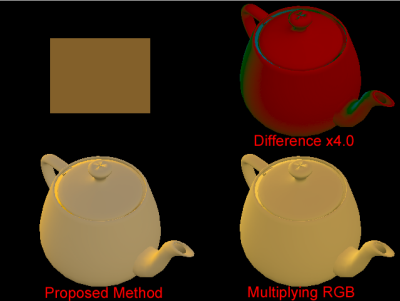
I propose a method for restoring Spectral Power Distribution (SPD) data from RGB image of skylight and calculating reflected color of synthetic objects lit by skylight.
The algorithm is based on basis functions of skylight spectra given by light scattering model in atmosphere so that measurement of the SPD is not necessary.
The method can be used to implement real-time environment mapping.
Precise simulation of lighting with skylight enables designer to interactively design the color of an outdoor visual environment.
Abstract(PDF)
The reflected color by this method is more bluish than the color calculated by just multiplying RGBs, because skylight's spectrum width is small in visible range.